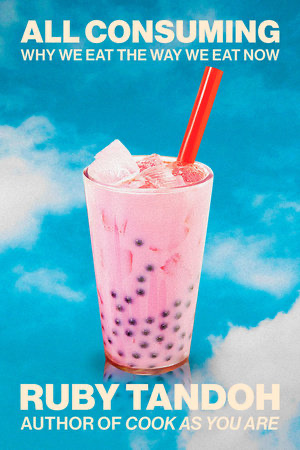
Ruby Tandoh. All Consuming: Why We Eat The Way We Eat Now. Knopf. New York. 2025. ISBN: 979-8-217-20786-2.
Richard Zimmer, Sonoma State University
We are all foodies now. We think about food all the time, we see food everywhere, and it is one of the cornerstones of our lives. That is the message of Ruby Tandoh’s important and well-written book. She traces the history of this development over the last century. Like any good storyteller, she names names and occasionally “dishes” some back story. By the end of the book, we know where we came from foodwise and where we are likely to go next.
Each chapter addresses a different aspect of our becoming foodies. The first sets the table—the creating, plating, and selling of food recipes on the Internet. By then, the idea of “foodie” had already been established (29-30). It was generational and it had roots in different countries. In the UK, for example, people “recovered” from the restrictions of the wartime economy and its postwar aftermath. Setting the stage, newspaper writers made culinary adventures de rigeur in their supplements. They “fed” new appetites, replacing the stodgy ones of pre-War Britons.
In the U.S., Craig Clairborne of the New York Times began high class restaurant reviewing in the early 1960’s, recognizing the new prosperity and concern of the paper’s lifestyle readers. His reviews began to focus on diners in upscale restaurants. But other diners wanted their concerns addressed as well. Duncan Hines addressed the middle-class travelers throughout the country. The Green book addresses the concerns of Black travelers who needed to know where safe eating and welcoming dining could be found. Keith Lee finds gems in ordinary restaurants. America was now a food travel world to be explored at all levels.
Foodies are socially influenced animals. Ever since the 1990’s, Tandoh notes, people look to social media to be part of the social buzz. Foodies, yes, and other types of people, line up in queues, the more the merrier. It is the experience itself, and various restaurateurs like Steak Shack promote it (89 et seq.) Boba/bubble tea is an example in point. Todah notes that it hit at the right time from abroad—both for market and social media. The colors of the drink worked excellently with visual social media and the phenomenon of queuing. Like hamburgers worldwide, it became an item. (et seq.) Tandoh then explains how social media, immigration, marketing, production processes and costs in the UK together worked and work to create the ever-changing variety of bubble tea [boba] offerings (pp.112 et seq.) It is useful by itself and useful for researchers and entrepreneurs in comparing other socially driven food phenomena.
Tandoh lays out the many social factors that lead to what happens in the home kitchen. Further, those factors lead to a real “video” picture as well. One example is the development of a post-WWII middle class in the US. This development has created a special role for the woman of the house. That role is portrayed in videos with the woman who does it all, taking care of the toddlers at the same time often making everything from scratch. Further, she is resting on the past work of women of color who set the stage, such as the fictional Aunt Jemima (130). “’Mistress of the lifelong dream’-this is the thing that counts” (131).
Cookbooks, to Tandoh, “,,,can tell us something about our food culture. They can even shape our diet, sometimes” (148). She then dips into English cookbooks, especially after the Second World War and the end of rationing. A new middle class was created. New immigrants came to the country. Cookbooks, which in the past were for the most part helter-skelter, gleaned from home economists and food packages, were startlingly replaced by the classic Elizabeth David’s A Guide to Mediterranean Cooking. This book set the stage for a food revolution—not so much as to what people cooked as to what they thought about cooking—and eating. Indian and Chinese cookbooks followed.
Tandoh then proceeds to analyze and categorize groundbreaking cookbooks in the UK. She argues that cookbooks come “…in exile, in migration, in moments of cultural warp” (162). She reviews the contents and influence of a number of cookbooks—worth reading. The posits a model of characterizing cookbooks: 1. Self-improvement- “…that promise to transform your body or wellbeing. 2. “…’problem solvers’, designed to make cooking as frictionless as possible or at least het it over and done with quickly.” 3. Dream-“Here there is less of the food, and more of the context” (167). This model may be useful and applicable for researchers to place the role a particular cookbook plays in history and in cultural change.
The dinner party. For the average person hosting one, it evolved from something small into a sort of potlatch [my choice of words] in the 1980’s. People went grandiose. Then it all collapsed by the end of the century. Too ambitious, Tandoh suggests. She then dishes out the back stories and dishes on herself, Jamie Oliver, Nigella Lawson, and Martha Stewart to present the best current advice: “Get into a Martha state of mind. ‘A youthful belief,’ as she puts it, ‘in the value of treats’” (184).
The next major food influencer is the supermarket. It is what shapes our choices. Tandoh sees this kind of store in words that will warm the hearts of consumers, anthropologists, political scientists, and historians. Anthropologists first: “This is where we perform our secular rituals—the slow procession around the stations of the shop…the awe of the supermarket [unlike the cathedral] is horizontal” (192). Political scientists will remember its effect on the Soviet Union during the Cold War—the promise of American capitalism, freedom, and democratic choice. The future of the supermarket is golden: Costco, Uzbeck supermarkets in Brooklyn: “Today even supermarkets have supermarkets (204.)” And convenience stores in Japan mirror supermarkets by carrying clothing that many supermarkets—and drug stores-often carry (Reference 1.)
Given the thousands of items in supermarkets, eye-catching packaging is crucial. So is what you put in them. Tandoh focuses on ice cream in the UK as a sterling example. Post-WWII manufacturers catered to the kid market, developing a huge range of products that could be sold in stores. The big boys, such as Unilever, started making food products because of the adult demand for higher quality and more variety—and in interesting packages that enhanced their sales appeal (212 et seq.) Adult ice cream eaters want to be dazzled—as they do with other food items. Consequently, Tandoh places British ice cream as iconic in terms of its production, marketing, and consumption. She places the evolution of the many forms of this item in terms of its becoming central to the culture of the nation, much like Cheddar Cheese, and foretells its future in new forms, such as vegan fiber ice cream (218 et seq.) In the same vein, musical lollipops are now available from Lollipop Star (see Reference 4.) It plays music while you lick it.
It is all a grift. So is the presentation packaging in the mass consumption of health and energy drinks. It started out that way in the beginning, with soda as an alternative to alcohol. Present-day, it is a multi-media fantasy created to address the fantasy of health and wellness. The irony, Tandoh notes, is that we have been here before: “Poppi was acquired by Pepsi” (234). Further: “’The future of soda is now’” (ibid). In the same vein, the history of fast food—from the Automat to present day chains with online ordering-is the way to cater to immediate desires (regardless of the behind-the-scenes cost to workers (242-248). Tandoh provides an excellent short history of these restaurants and their development. It is worth exploring Lorraine B. Diehl and Marianne Hardart’s nostalgic picture of the Automat as well (2002).
In her final chapters, Tandoh puts the icing on the cake with her history and analysis of post-WW II Britain, the rise of Blimpy’s, its loss to McDonald’s and then other American fast-food chains and influences, and the McDonaldization of the world (cf. Reference 6, George Ritzer’s accurate and prophetic account of the McDonaldization of the world). She says “…it’s America that sets the bar” (264). What wonders will the world now see with the iconic American style egg salad sandwich on Japanese milk white bread in the similarly iconic American 7-11 chain now owned by the Japanese (Reference 9)? Her epilogue is a worth-reading restatement as to how she started on this journey of food influences and food influencers. And her Further Reading section is particularly useful for general and specialist readers. Also useful is her recent podcast (Reference 10.)
This book is useful for academics, university students, and the general public interested in the history and social and cultural influences determining and affecting the way in which people choose what to eat, where to eat it, why, and when.
BIBLIOGRAPHY
2002
Lorraine B. Diehl and Marianne Hardart. The Automat: The History, Recipes, and Allure of Horn and Hardart’s Masterpiece. Clarkson Potter: New York.
References
1-
2026
(Accessed January 8, 2026)
2-2025
Japanese food machine park
https://www.youtube.com/watch?v=CkbZH7U40Ck
(Accessed January 8, 2026)
3-2025
Many Japanese food machines
(Accessed January 8, 2026)
4-2026
Lollipop Star
(Accessed January 8, 2026)
5-Home Robot cooker
https://www.thechefrobot.com/?srsltid=AfmBOopCaarU5cMnb0UKOR7tx_jnPSMjO8iVXGZIeE6ecgmgS9pE-hi3
(Accessed January 8, 2026)
6-The McDonaldization of Society
https://onlinelibrary.wiley.com/doi/10.1111/j.1542-734X.1983.0601_100.x
(Accessed January 8, 2026)
7-Restaurant Robot Cooker
(Accessed January 8, 2026)
8-Food Delivery Robots
(Accessed January 8, 2026)
9-7-11 Egg Salad Sandwiches
https://www.7-eleven.com/products/fresh-chilled/egg-salad
(Accessed January 8, 2026)
10-Ruby Tando Podcast
(Accessed January 30,2026)

 FoodAnthropology