
Bittersweet: Living with sugar and kin in contemporary Scotland. Imogen Bevan. PhD in Social Anthropology, University of Edinburgh. 2022.
Francesca Vaghi (University of Glasgow)
Sugar – and the pleasures and anxieties it evokes, often simultaneously – is ubiquitous. This is a well-known story, yet one that is told in a novel and captivating way in Imogen Bevan’s thesis on sugar and kinship, set in the Edinburgh neighbourhood of Leith. By weaving together the stories of children, parents, grandparents, school staff, and a variety of other actors, Bevan immerses the reader in the lives of her participants, whilst applying a critical lens on the policy and mainstream discourses that impact these lives. The thesis is organised in two parts. Part One, ‘Sugar “in Public”’, offers an account of sugar’s ambiguous position in the school environment, both as a positive substance that is fundamental for children to foster ‘sticky’ relationships with each other (Chapter 1), but also as an object of risk to be monitored and restricted through policy messages and interventions (Chapter 2), and at the interface between the school and home (Chapter 3). Part Two, ‘Sugar “in Private”’ turns to the sphere of the household by exploring mothers’ and fathers’ narratives in Chapters 4 and 5, then moving slightly outwards in Chapter 6 to the sugary transgressions grandparents and grandchildren engage in together. The concluding chapter of the thesis explores yet another blurry terrain – both nutritional and relational – by examining the (unpaid) work of five women in the community, who bake cakes for children “who might not otherwise get one” (pg.211) due to a variety of (usually) socioeconomic circumstances.
Throughout the thesis, Bevan masterfully describes how sugar’s contradictions manifest at different levels, and how these contradictions impact kinship ties in myriad ways. Bevan’s reflective and open approach is evident throughout, showcasing both the methodological and analytical strengths of ethnography, and encouraging readers to question their own preconceptions about matters that – as stated above – we might think we already know all too well. It is difficult to do justice to the entirety of this thesis in a brief review so, in what follows, I will focus on some of the aspects of Bevan’s work that struck me as most significant, predominantly the discussions developed in Chapters 2, 3, and 4.
Childhood and sugar in the UK context
The expansion of research about childhood, within anthropology and the social sciences generally, has firmly established the notion that there is no single understanding of ‘childhood’, nor is this stage of life experienced equally across intersections of race, class, gender, nationalities, and other categories (e.g. Twum-Danso & Ame 2012; Spyrou, Rosen & Cook 2019). Similarly, many scholars have shown that global concerns about children’s diets – particularly around sugar consumption and obesity rates – can manifest in very localised ways (e.g. Yates-Doerr 2016; Warin & Zivkovic 2019).
The prevailing view of children in the UK seems to be one of the child as simultaneously vulnerable and deviant, both in need of protection and intervention (Moran-Ellis 2010). Bevan’s ethnography brilliantly exemplifies this general attitude, and demonstrates how it impacts discussions about sugar between children and adults. In Chapter 2, we encounter the deployment of public health messages about oral health as a palatable approach to talk about sugar avoidance in nurseries and schools, as raising awareness about the risk of tooth decay is considered more ‘neutral’ territory than discussing the risk of obesity (p.87). Yet, in seeking to ‘protect’ children from both sugar and from potentially developing a negative body-image later in life, adults fail to recognise that children are already aware of (and engage with) the discourses about diet and weight gain around them. At the same time, we see adults unintentionally concealing the contradictory relationships that they themselves have with sugar, often admitting to Bevan how much they enjoy sweet treats despite knowing these are ‘bad’ for them, and despite the authoritative roles they may take in teaching children about the ‘dangers of sugar’. Framing sugar (and often food in general) simply in nutritional terms inevitably obscures the fundamental role it plays in fostering caring relations.
Another quintessentially British element we encounter in the thesis is the vivid description of how the UK’s mixed economy of welfare works in practice, marked by its varied implementation of different policy initiatives by public, voluntary, and private actors. The discussion of ‘Fruity’, a local primary school’s programme aiming to replace ‘unhealthy’ snacks brought from home with fresh fruit and vegetables, is particularly emblematic of the unintended consequences of policy interventions only focused on food’s nutritional value. Aside from rupturing some families’ caring practices (something I will return to later in this piece), it was particularly striking to read about the framing of this intervention within the language of children’s rights in Chapter 3. Bevan describes the school’s attempts to ‘empower’ children by teaching them about their right to food, and encouraging them to model ‘healthy behaviour’ among their peers and within their households. Bevan does not explicitly point this out as ironic, but as a reader I asked myself: are children being empowered to do what they want, and to support their wellbeing on their own terms, or are they empowered to do what adults want them to? Children’s rights in this context are ‘ambiguous, in Bevan’s words (p.91), and seem to become a mechanism by which adults police children’s behaviours. Bevan notes the parallels that emerge between learning about ‘healthy eating’ and learning about children’s rights; “being healthy overlaps with the school notion of ‘making good choices’” (p.118), she says, with a line being drawn between “Health and probation, good and bad, law-abiding citizen and outlaw” (ibid.). Yet, we also see children resisting these forms of disciplining by adults. In an amusing vignette transporting us to a scene in a school corridor, Bevan describes how children also monitor adults’ consumption habits, challenging the idea that adults influence children’s behaviour in a unidirectional manner:
“[Seven-year-old] Logan gives me a secretive grin. ‘You want to see something?’ He puts his finger to his lips, and beckons me over to where he is standing. ‘If you come right here, you can see the teachers eating their lunch!’ I crouch down next to Logan – he adjusts my position – and he’s right. From this very specific angle, peering down the spiral staircase through the murky glass window panels, you can spy Mrs Reid laughing animatedly with Mrs Peterson, over a low table scattered with a variety of meal deal sandwiches and colourful plastic wrappers […] ‘Maybe they drink alcohol down there’, older girls whispered to me between raucous peals of laughter. And apparently, Mrs Jeffrey had once been spied drinking a Diet Coke […] Moments of surveillance or control over adults’ eating emerge as enjoyable” (p.108).
Bevan’s analysis about the implementation of ‘healthy food’ initiatives within schools, with the inevitable involvement of nutrition ‘experts’, would have been strengthened if situated within some discussion of the growing prevalence of “food pedagogies” (Flowers & Swan 2016) within schools, and other settings.

Class and gender
The link between ‘good food’ and ‘good parenting’ is salient in the literature (e.g. Harman, Cappellini & Faircloth 2019), and showing how this relationship manifests across class and gender is a welcome contribution of any new scholarship that explores this topic. Bevan’s ethnography makes evident that the moral value attached to food – which is amplified in the case of sugar – weighs differently on working-class parents, particularly on mothers. “Eating for health,” Bevan argues, “is not only often unfeasible, but often experienced as non-conducive to social relationships” (p.24, original emphasis). This deepens already existing (health and social) inequalities, creates new ones, and generates contradictions – nutritionally valuable foods may not be ‘sticky’ enough, in Bevan’s terms, to keep kinship ties strong.
The ‘Fruity’ initiative mentioned above, for example, where a local primary school discourages children from bringing morning snacks from home (which often include chocolates, bags of sweets, or other ‘unwanted’ foods) is in part based on the unspoken assumption that some parenting practices are inadequate and need to be rectified. The initiative, however, inadvertently severs acts of parental care (for families of all backgrounds), and also interferes with children’s modes of relating at school, given that sugary treats are often shared (or denied) among peers, ‘thickening’ or ‘thinning’ relationships between them. ‘Fruity’s’ position within the children’s rights framework emerges as contentious again when we discover that, for some children, not bringing any snacks from home might mean they will not eat a morning snack at all: “You can’t just take away their snack! What about the kids who don’t like fruit? The least is to offer some other options,” one mother says to Bevan (p.92). The initiative is not received equally by all parents in the school, and is perhaps experienced as most antagonistic by parents who are aware that it is their practices that are being negatively perceived. Based on observations of school staff and parent council meetings, Bevan explains that, “Implicit within [‘Fruity’], is the wider narrative of particular populations being out of control with their consumption and pleasures […] Underlying the disapproval of the ‘family bag’ of sweets, is an unspoken comment on inadequate parenting, passivity and potential insouciance regarding children’s futures” (p.90). Like the assumption that children are observed by adults but that the opposite does not happen, the paternalistic assumption that ‘target families’ are not aware that they are subjects of policy interventions is evident here.
Whilst sugar can acquire a particularly dangerous quality for parents who are less well off financially, or who are minorities, Bevan shows that feeding and eating sugar produces anxiety especially among mothers, regardless of their background. She coins the notion of ‘bittersweet’ to describe “how instances of pleasure in sugar become tainted by the perception of negative moral and physical consequences on bodies and relationships,” and also to specifically “[attend] to the ways in which conflicting knowledge and public health messages about sugar’s harms can haunt women in everyday life” (p.134). It is crucial to evidence that women still carry the brunt of foodwork even in contexts like the UK, where a certain level of gender equity is assumed and expected, because policy language that refers widely to ‘parents’ obfuscates that it is usually women who are held responsible for children’s diets. It would have been interesting for Bevan to more deeply explore how the notion of ‘bittersweet’ manifests in the experiences of low-income families.
Sugar across generations
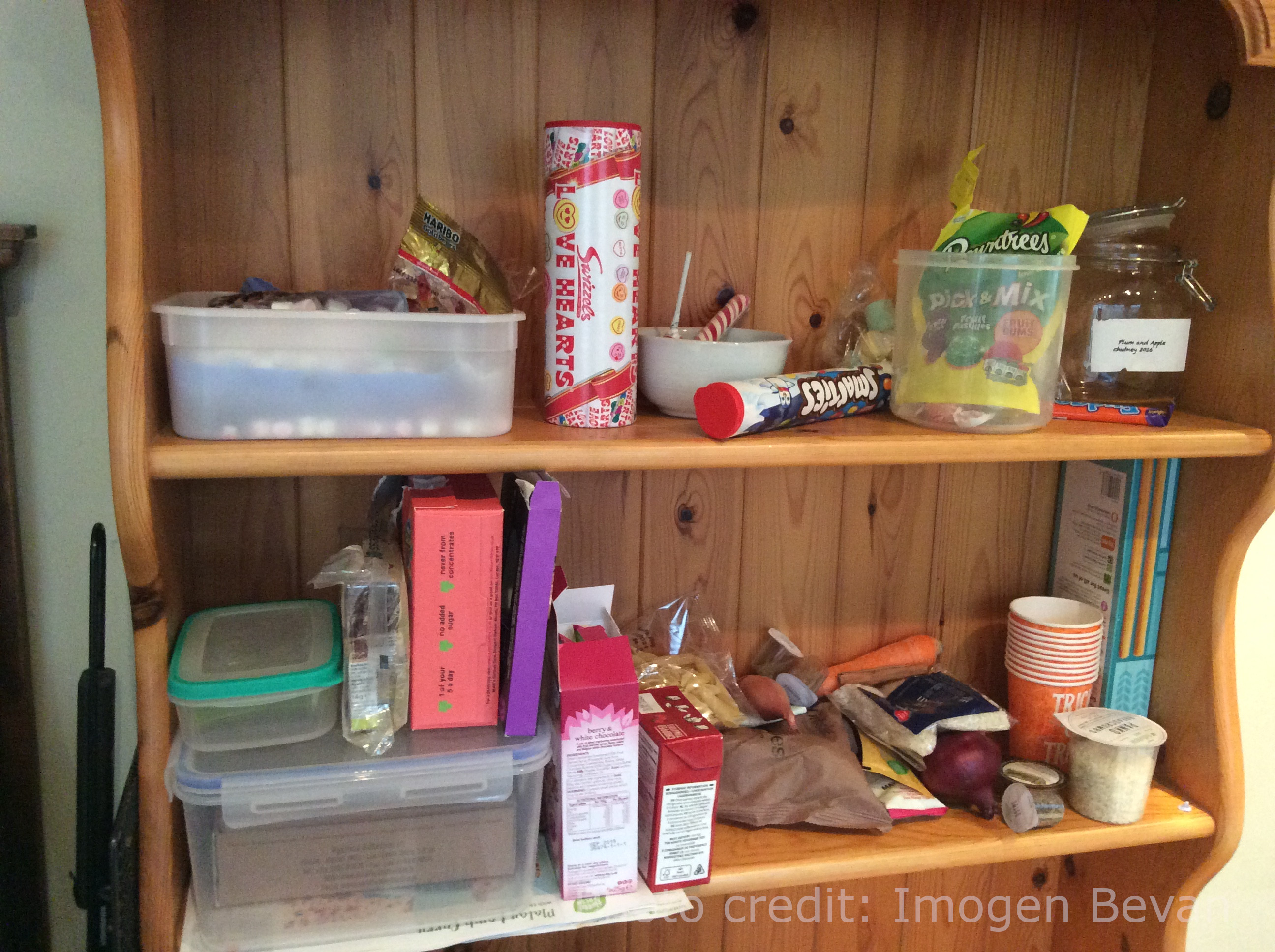
Bevan’s thesis is a rich contribution to scholarship about intergenerational relations, charting the movement of knowledge and practices related across generations at a granular level (pun intended). It is not only knowledge and practice that moves between members of different kinship groups, it is also sugar itself, the substance, that moves from body to body. This rings particularly true for mothers, who in their narratives reflect at length on the impact that consuming sweet foods during pregnancy, or when breastfeeding, may have had on their children’s palates. In a rich passage where a participant talks about her own eating habits (from her childhood memories of consuming sugary treats with grandparents, or of eating ‘too many’ sweet foods when in fraught romantic relationships), Bevan describes:
“[June’s] memories move from house to house – her parents’, Nana’s, Granny’s, a flat with her boyfriend, the tenement in Edinburgh – each with their own sugary configurations, set-ups of cupboards and drawers with particular contents. Given this set of relations, the unstoppable transmission of sweet tooth from womb to womb and from house to house, June is terrified that [her children] ‘do it’ – gorge or binge on sugary things – or that they will come to […] The cycles and downwards transmissions of sugary habits and substances show the uncertain chancy transmissions of things between people. Did June’s sugar-fuelled diet during pregnancy produce a sweet tooth?” (p.140).
Such accounts show the consequences of inhabiting a policy environment that is predominantly preoccupied with emphasising the link between increased knowledge and behaviour change: contradictions emerge constantly, conflating the ‘good’ with the ‘bad’. In participants’ narratives, even the policy mantra that “breast is best” is overshadowed by the dangers posed by sugar:
“Maternal breastmilk was often cited by interlocutors as children’s – and the species’ at large – reason for liking sweet tastes. A shared (sugared?) substance, breastmilk emerges both as the epitome of maternal care and a possible source of harm” (p.102).
The possibility that one’s caring practices might cause harm to those we love is a bittersweet taste indeed.
Concluding remarks
I hope I have made justice to what I think are some of the key contributions that Bevan’s thesis makes to anthropology and childhood studies, particularly the impact that “Health messages about sugar [that] focus on evaluating, rather than enjoying, foods” (p.98) can have in people’s lives. I would like to finally commend this author for successfully developing a child-centred approach that amplified her young participants’ viewpoints and experiences, the importance of which cannot be overstated. I do hope we will soon see Bevan’s work published next to other recent monographs that deal with similar themes, such as Zofia Boni’s 2023 Feeding Anxieties: The Politics of Children’s Food in Poland, or Gurpinder Singh Lalli’s Schools, space and culinary capital (2022).
References
Boni, Z. (2023). Feeding Anxieties: The Politics of Children’s Food in Poland. New York: Berghahn Books.
Flowers, R. & Swan, E. (2016). Food Pedagogies. London: Routledge.
Harman, V., Cappellini, B. & Faircloth, C. (2019). Feeding Children Inside and Outside the Home: Critical Perspectives. London: Routledge.
Lalli, G. S. (2022). Schools, space and culinary capital. London: Routledge.
Moran-Ellis, J. (2010). ‘Reflections on the sociology of childhood in the UK.’ Current Sociology, 58(2), 186-205. https://doi.org/10.1177/0011392109354241
Spyrou, S., Rosen, R., & Cook, D. T. (2019). Reimagining childhood studies. Bloomsbury Academic.
Twum-Danso, A., & Ame, R. K. (2012). Childhoods at the intersection of the local and the global. London: Palgrave Macmillan.
Warin, M. & Zivkovic, T. (2019). Fatness, obesity, and disadvantage in the Australian suburbs: Unpalatable politics. Springer International Publishing.
Yates-Doerr, E. (2016). The weight of obesity: hunger and global health in postwar Guatemala. Oakland: University of California Press.

 FoodAnthropology
The following phrase seems an excellent observation that opens up a window to peep through and see the gist of Bevan PhD.
“the unstoppable transmission of sweet tooth from womb to womb and from house to house”