Emily de Wet
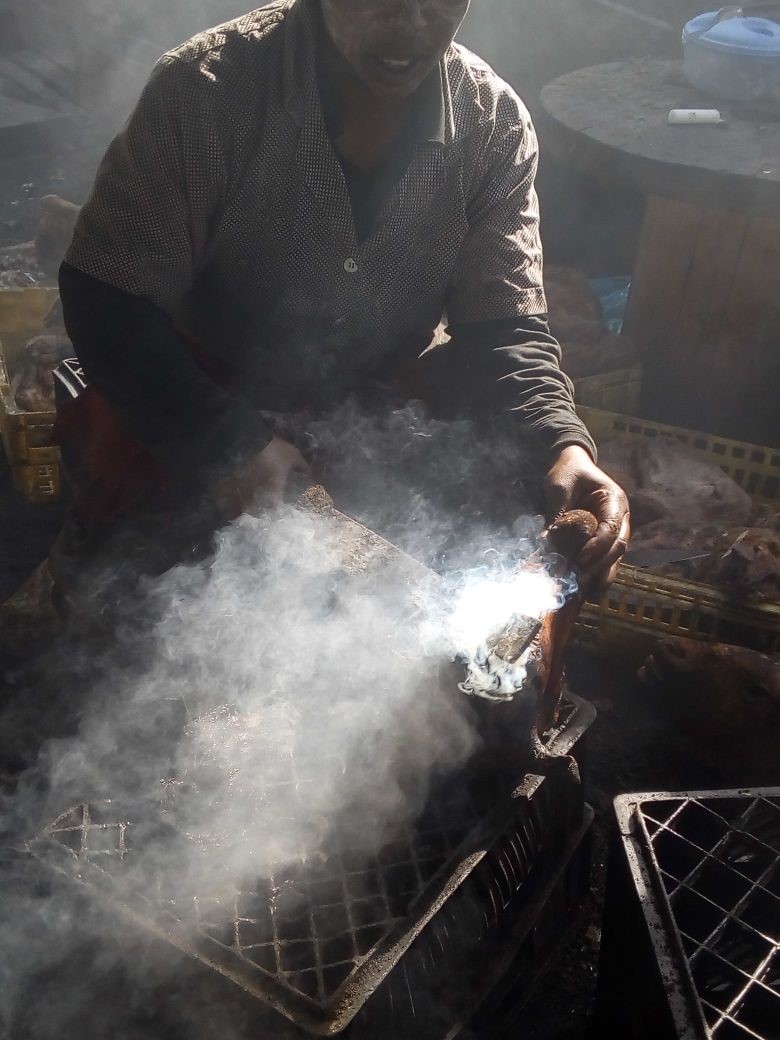
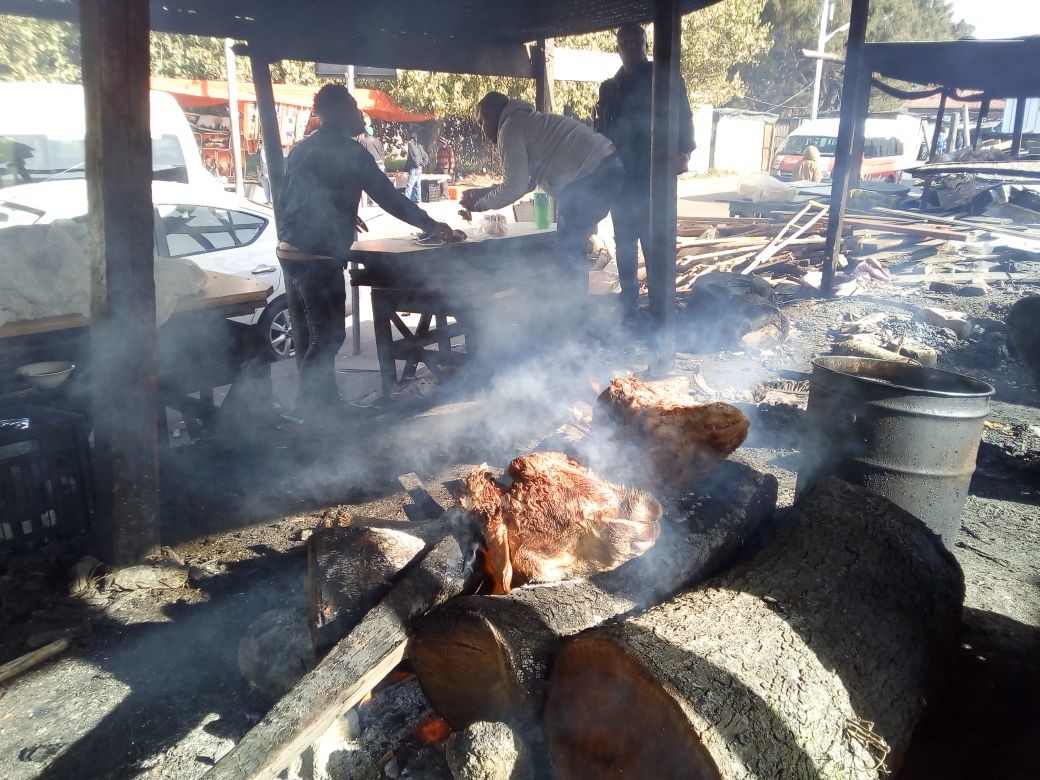
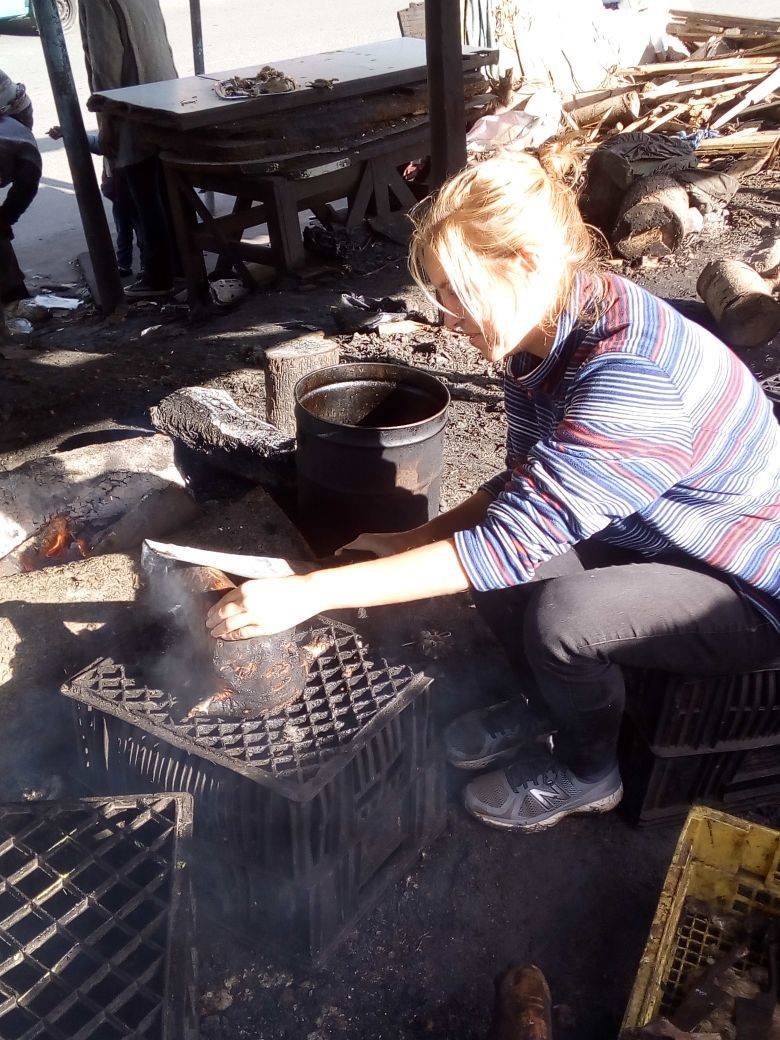
I sit with Yonela (a pseudonym) as smoke collects under the wooden awning built to protect her and other women from the elements as they prepare sheep heads, known as smileys, in Cape Town, South Africa. The fire, which was started a few hours ago, is roaring, with large flames lapping up between the huge logs, charring the sheep’s heads so we can more easily clean them of their wool. This cleaning happens in four steps. First, she uses metal shears for the longest wool which falls to the dirt in tufts as she goes. Next, the heads are placed on the fire, where we periodically remove them to rub the remaining wool off with steel wool. Perching them on plastic crates, we carefully balance them to not burn our own flesh as we scrape, and then place them back on the fire. This process is repeated and then followed by the searing of the sheep’s now nearly naked skin with a hot, flat metal rod. Smoke pillows off of the head during this stage; it lingers in the air along with a sharp squeak as the metal presses into the flesh. I struggle with this part, but Yonela is nimble, and her decisive movements with the metal piece give no indication of how heavy and unwieldy the metal or the head are, both blisteringly hot. The final stage is to scrub them clean in large pots of water before they are split open with an axe, the brain is removed and thrown away, and they are boiled in a large pot for two hours before they are served or put on display for customers. A group of three men have just bought a smiley from Yonela and are enjoying it nearby, sharing it, a loaf of bread, and a bottle of cool drink while they socialize. Sheep heads get called smileys because of how their lips curl up when cooked; prepared this way, the ears are tastiest to nibble on, while the cheek meat is the most succulent. Sheep heads become smileys through laborious, skilled work, through the conviviality of a shared meal, through the complex meaning people attach to this food.
Not long after this small group finishes eating, a local tour guide brings a group of white foreign tourists by, telling the group that these women “recycle” the sheep heads, making a business for themselves from the offcuts. The tourists ogle at the heads, splayed open on the wooden table in front of the stall, covered in lace fabric to keep the flies away. Yonela humors tour groups and the stories guides tell – all adding their own “flavor” as she puts it – but her mood sours as she hears him call her business “recycling.”
Sheep heads have economic value in the food industry, but almost exclusively outside of the formal food industry because they’re deemed inedible to white South Africans who still dominate many economic markets. And yet there is much more to their story. Picking up here, I explore the multiple forms of value that sheep head’s hold in Cape Town, South Africa, arguing that only seeing their value as that of economic commodity for people in poverty is a telling that embodies the racism of erasure – it misses the complex social and economic value smiley’s have, and the importance of women’s labor to make them.
The sheep head industry arose during apartheid as Black women moved into townships: segregated areas at the urban margins built during apartheid to house Black people outside of the city. Townships were and remain the most visible mark of apartheid and its policies of racial segregation, racial inequality, and exploitation of Black labor. With continued lack of investment, townships are characterized by outsiders through high unemployment, poverty, and high rates of interpersonal violence manifesting from the complexities of these structural violences.
During apartheid, with few options for employment, many women without an education either opened shebeens (bars) or sold meat. Much of this meat was offal – offcuts that weren’t sold in formal markets, making them accessible for people with very little capital to purchase and turn into edible food, turning a small profit. For some women, this was a side job with dignity, as their work as nurses or cleaners meant long hours of degrading work, racism from coworkers/bosses, and little mobility. Some of those women turned their small meat selling businesses into larger ones, moving from informal work to brick and mortar stores. Businesswomen who didn’t have other access to capital, or were unable/uninterested in expanding, laid the foundation for a thriving informal meat industry, visible in concentrated areas of street vending in Langa, Nyanga, and Khayelitsha townships where all kinds of meat and offal are sold, including whole chickens, intestines, and sheep heads. This industry meets the needs of people living in poverty, while also providing jobs that people, especially women, can move in and out from depending on their other employment and family’s needs. Through generations of hard work by (mostly) women, sheep heads move from being inedible to edible commodity, but even this slightly more complex telling is incomplete.
While sheep heads may be offal in formal markets, they are also a delicacy amongst Xhosa people, and consumed only by elder men during Xhosa ceremonies in which a sheep is slaughtered and different parts of the animal are served to different groups based on age and gender. The slaughter of an animal and sharing of its meat is central to many Xhosa practices, including funerals, weddings, circumcision practices, and thanks-giving ceremonies. Not just an edible food, among Xhosa people, sheep heads have high value, not as commodities, but rather highly valued within social ritual events. The sheep head industry in Cape Town has made this high value food more accessible to all. Yonela tells me that in the Eastern Cape she cannot eat a sheep’s head, but in Cape Town, she and any other woman can have them whenever they like. Indeed, smileys are so popular that Yonela’s seller must ration out his stock to the many women who buy from him.
People buy sheep heads as an affordable treat that is shared and savored. They are bought by people living in poverty, and people who value this as a taste of “African food,” a framing that distinguishes it from the range of cuisines available in Cape Town, and which many of my interlocutors associate only with townships or rural areas. These associations of smileys with “African food” and with inexpensive food are complex; smileys are associated with a taste of home for some, and of “when we had nothing” for others. But few deny that this food simply tastes delicious. Costing between 60 and 70 rand per head, depending on cost fluctuation from butcheries (approx. 3 USD), this food might be a shared meal, an afternoon snack, a treat, a comfort. Eaten together, this food also builds social relationships, whether eaten at ceremonies or beside a food stall. Alongside its economic value, it is also a socially valuable food.
Discounting this complexity is part of the racism of erasure of townships in their complexity; seen from the outside as places of poverty and violence, not as sites of significance or social value. Without this complexity, the only value legible in townships is one of low economic value, perhaps with the inspirational (and condescending?) undertone of women finding a way to “recycle” what white people won’t eat. But as Yonela shows us, it is incomplete, missing the sensory pleasure of eating sheep heads, how it solidifies social relationships through conviviality, and manifests connection to Xhosa and “African” foodways in a highly segregated city. It ignores the way that women’s work has built this industry, reshaping the spaces of townships, and creating delicacies.

 FoodAnthropology