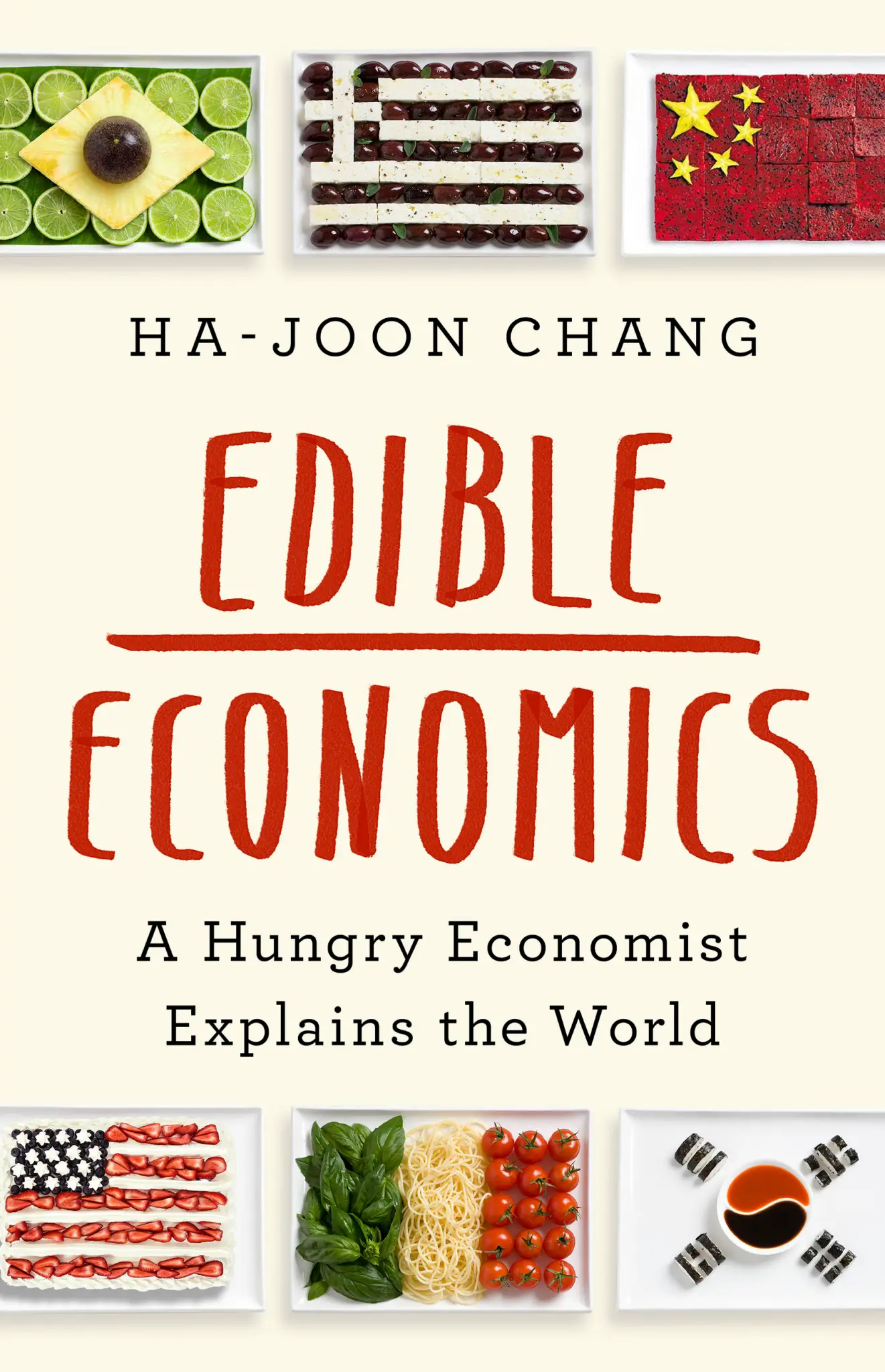
Ha-Joon Chang. Edible Economics: A Hungry Economist Explains the World. New York: Hachette Book Group, 2022. Xxvi + 192 pp. ISBN #9781541700543
David Sutton (Southern Illinois University)
This has been a strange book. Those are not my words, but the first line of the book’s conclusion. It is a line, however, that I agree with. Is this a book about food? Not exactly. Chang is a “hungry economist,” happy to share his thoughts about recipes, ingredients, and their diverse histories, as well as to share thoughts about economics. But as he points out, this is not, for the most part, a book about the economics of food. In the introduction, Chang briefly suggests, “I am trying to make economics more palatable by serving it with stories about food” (xxv). But he hedges this remark, noting that the food stories are, in fact, “not bribes” to get you to eat your vegetables. He believes vegetables to be very tasty as well.
So, what to make of the eighteen chapters in this book, each one titled after a particular ingredient (Garlic, Chicken, Lime, etc.), and none of them more than 8-10 pages in length? Chang’s main target is to unpack and challenge some of the platitudes of the neoliberal economic orthodoxy of the past 40 years, as well as general stereotypes, like Samuel Huntington’s ideas about the relationship of economic development and culture (see “Acorn”), complicating the connection between economic and political freedom, by reminding readers, for example, how the products of slavery in the U.S. helped “enabl[e] the US to mobilize capital on a global scale and also to develop its financial industry into a global player” (“Okra” p. 15). But what does this have to do with food? No doubt a lot, as Sidney Mintz, among others has shown. But here Chang uses okra merely as an entrée into the subject of African-American contributions to the U.S., and ends with what seemed to me a weak analogy:
“In the same way in which it binds ingredients in a dish together in cooking, the story of okra told in this chapter binds the intertwined stories of economic and other freedoms and unfreedoms under capitalism…” (p. 19).
If Chang’s target is neoliberal free market shibboleths, his model for economics leans towards Keynesian regulated markets, with occasional insights from Marxism and Feminism mixed in.[1] Several chapters explore the importance of using government protective measures to nurture infant industries, such as Hyundai in South Korea, and also not seeing productive capacities of countries as somehow fixed and predetermined, as much of the IMF and World Bank policies long did. I puzzled over the connection of these insights to a lovely description of the diversity of pasta shapes and ingredients in Korea and Italy, however. It seems that a famous Italian industrial designer, Giorgetto Giugiaro, attempted to design the “ultimate pasta shape” (which failed), but also designed cars, one of which was the first car to be produced in South Korea by Hyundai. In examples like this, the connections to food, Chang admits, are often of the stream-of-consciousness variety (160), although I admit that I got swept up in his descriptions of noodle varieties before delving into car manufacturing.
Aside from metaphor and stream-of-consciousness, anecdote serves in some chapters as the mode of connection between food and economics. A chapter on different definitions of social and economic equality is framed by a story about a flight on the Soviet airline Aeroflot, in which a friend was told that everyone gets the same—chicken—whether or not they are vegetarian. Chang uses this to make the point that equality of opportunity or even equality of outcome must also take into account different “needs and capabilities” (Chicken p. 112). Another anecdote frames that chapter on Chilli, in which a Sichuan restaurant in London still included the spicy ingredients even in dishes that were not marked as “hot,” to the dismay of his dining partner. Noting that “when something is ubiquitous, it is taken for granted,” Chang uses this example as a lead into a discussion on the problem of not counting unpaid care work as part of economic activity and devaluing paid care work because of its gendered associations. He stresses the connection: “Food without chillies is unthinkable for billions of people around the world. Life without care work, whether paid or unpaid, is unthinkable for all humanity. But their very necessity and thus ubiquity make chillies and care activities invisible and thus undervalued—or even unvalued” (Chilli, p. 119-120). Indeed, and in this case the analogy makes sense.
The strongest uses of food are in chapters where he doesn’t rely on metaphor, but rather the metonymic connections are able to connect food and economics. The chapter on chocolate begins with a brief (standard) history of the substance, followed by a discussion of Swiss chocolate manufacture being jumpstarted by technological improvements made by Nestle. This leads to a discussion of Swiss production more generally, showing that—once again contra stereotypes—Switzerland is not a post-industrial country with chocolate, banking and tourism as its signature products. In fact, Switzerland is the most industrialized country per capita in the world (even if many of the products it produces are “producer goods,” rather than consumer goods). Chang uses this account to suggest that economic health might not demand the kind of pure services economy that is often promoted by “the myths of post-industrialism” (Chocolate, p. 155). Once again, emphasizing that government promotion of manufacturing can be the route to prosperity.
Who is the reader for this book? I would say that food scholars who are unfamiliar with most recent economic thinking might find this a good introduction to the failures of free market thinking from a neo-Keynesian perspective. And perhaps in the course of reading this book you might find a chapter that would work as a discussion piece in your food studies class, or even in an introductory anthropology class (on global interconnections, perhaps). Some of the connections, as I’ve suggested, are too weak even to sustain that possibility. But, at his best, Chang presents interesting culinary tidbits alongside clear writing and clearly expressed economic ideas. For that, the “Hungry Economist” deserves kudos.
[1] Chang still retains elements of neoclassicism, in claiming, for example, that markets are, as Hayek claims, information processers, and that they provide incentives to raise productivity (p. 119, fn).

 FoodAnthropology