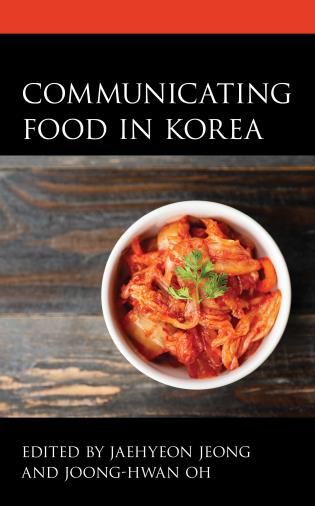
Jaehyeon Jeong and Joong-Hwan Oh, (eds). Communicating Food in Korea. Lexington Books. Rowman and Littlefield. Lanham, Maryland. 2021. 267 pp. ISBN: 9781793642271.
Richard Zimmer (Sonoma State University)
Jaehyeon Jeong and Joong-Hwan Oh have produced a necessary collection of diverse essays about many aspects of food in Korea, primarily South Korea. Many of the essays are now available in English for the first time. They range from the history of Korean food to the development of a “Korean” national cuisine and to the internationalization of Korean food. They include the ways in which domestic politics and economic policy combine with foreign trade and defense policy to shape the internal and export food industries. The time period of the essays ends in the latter part of the second decade of the Twenty-First Century.
In Chapter 1, Chaisung Lim examines historically and critically the Japanese land reclamation projects in the Twentieth Century under the period of colonial rule. Unlike Taiwan, which could produce both rice and sugar because of its climate, Korea could only produce one crop (13.) The Japanese set up a system of land reclamation to promote homeland immigration to Korea and Korean immigration to Japan, in effect, trying to blur the distinction between the two areas (18). The plan largely failed. During the Colonial period, the Japanese in Korea held more rice-producing areas than did Koreans. The reclamation projects over time gave the Korean Peninsula more food sovereignty. Food sovereignty, as will be portrayed in the book’s later chapters, is crucial in the development of contemporary Korean food and cuisine.
In Chapter 2, So-yon Yi addresses the role that food plays in post-Korean war novels. Following Marcel Mauss and focusing on two novelists, Yi sees the earlier pre-war period as one of communalism, of sharing of food as the tie that binds, especially in rural areas. Food is intimately connected with a more nurturing and caring society. Depending on the writer, the War itself is a time of deprivation, hunger, breaking social ties, losing the past, of losing tradition. (These novels recall similar periods in China and Cuba.) Even the recovery from the war is a time of humiliation when American soldiers threw sullied foodstuffs at Koreans (41). The modern period, to the novelists, is one of ‘The City’–individualism, struggle, violence, and a loss of the past. Yi sees that now that food is available and plentiful [in South Korea], the “semantic” role that food plays in life and literary works is “…much more delicate (46).”
In Chapter 3, Byong-Seon Yoon and Wonkyu Song address the post-WWII food history of Korea and the development of a food sovereignty movement. The immediate post-war period meant that eventually South Korea was brought into the American strategic orbit as a counter to Communist expansion. The US wanted to ensure food availability, which also meant including US food exports. But this policy was contradictory to the development of South Korean food sufficiency (49). In the ensuing period, the government tried to encourage monoculture and high-yield production of grains, rice, and meat. The result was fluctuations in the home market, forcing peasants off the land and raising prices, which impacted the availability of food for poorer groups (53).
As a reaction to the chaos and deprivation of this industrial food policy, alternatives developed, starting in the 1960s. These included organic farming, initially promoted by religious groups, and small peasant farming, often connected to women’s rights groups. A food sovereignty movement took hold in Korea, in part inspired by and connected to worldwide movements (see Matthew Canfield’s excellent work on this topic in 2022.) These movements were reinforced by a change in the school lunch programs across the country, from corporate servicing to local school servicing. The authors note that the complex, multifaceted, and evolution of Korean agriculture invites future research on the interactions between these movements and food production (62-63).
In Chapter 4, Hong Sik Cho portrays kimchi as the symbol of [South] Korean nationality. Kimchi, preserved vegetables, is strong in smell and flavor. Post World War II, South Korea moved from a largely peasant country devasted by colonialization and war to a modern, industrialized, and urbanized powerful world player. Kimchi became the symbol of its national identity and pride. Interestingly, it represented “traditional” Korea—a food created at home by peasant women. Furthermore, it was acceptable to the new student activist class because it represented both traditionalism and a non-elitist foodstuff (74). It made South Koreans stand out because of its distinctive smells and because it was eaten at every meal. By the 1980s, it made Koreans “Korean.” Even though kimchi production became industrialized, kimchi has now been promoted as having spiritual qualities (see Reference 1) and health benefits (76).
Kimchi has become mythological as well, with attempts to place its origins in the Three Kingdoms in China (220-280 CE). Cho points out more recent origins, starting in the 16th Century CE, with cabbage, its often most familiar ingredient, coming in the 19th Century CE. In recent times, starting in the 1980s, kimchi was promoted in the Olympics and tied to other evolving aspects of Korean national identity, such as its alphabet and its martial arts. It also became involved with state sponsorship domestically and internationally and it became tied to specific other products, such as kimchi refrigerators, appliances specifically designed for the condiment.
Lastly, kimchi became caught up with South Korea’s international politics. Kimchi was also produced by Japan and China, starting in the latter part of the 20th Century. (South) Koreans saw the challenge as an affront to them and their development of food sovereignty. Charges were made, for example, Chinese kimchi contained lead and egg parasites. The Chinese responded, making the same accusations in turn. It is also disturbing that the vaunted health benefits of kimchi, whatever its source, are offset by its potential for causing gastric cancer (84). And there is a further irony: the biggest producer of Korean kimchi is China, with mainland based companies (86).
In Chapter 5, Seung Sook focuses on the history and present development of Korean Buddhist Temple food. Originating in China during the aforementioned Three Kingdom period, Buddhism and Buddhist Temple food spread in the monasteries and nunneries. The food was vegetarian, except for illness. Temples were located throughout the peninsula, including the cities and countryside. And they were elitist. Then, Confucianism displaced much of Buddhism. What remained were poor temples, primarily located in rural areas.
Foodstuffs were more often grown and prepared by slaves and women, whether in temples or nunneries. After the period of Japanese colonial rule and the Twentieth Century wars, the newly industrializing South Korea began to prize Temple foods as another form of traditional and healthy foods. This development mirrored similar patterns elsewhere, as modernization also led to a diet of more fast foods and the consumption of more fat and sugars.
South Korean Temple foods continued to be a way of asserting identity through traditionalism. Temple food joined the international slow food movement (see Reference 1.) And it was taken up by non-Buddhists in South Korea as well, an important development because more than one-quarter of South Koreans are Christians. Women and men have been taking Temple food classes—both for home use and for business purposes. Soon suggests that the nature of the South Korean economy, where fewer people work in large businesses, gives people a chance to work in small enterprises (104). Lastly, Temple food has been promoted internationally as part of (South) Korean identity in different venues and expositions. Changes in the country’s economy, such as more leisure time, for example, have led to a rise in Temple food classes, restaurants, and Buddhist meditative practices (106).
In Chapter 6, Jeehee Kim addresses the history and mythologizing of Temple food in the past for Korea as a whole and, more specifically, contemporary South Korea. Briefly, Temple food developed in somewhat different ways in Korea because the influence of Buddhism from China drew from different Chinese and Indian sources, including whether meat was consumed. Later, and unlike in other countries where temples were likely to be in urban settings, those in Korea were relegated to rural and mountainous areas. In other countries, the religious begged for food. In Korea, the religious grew their own foodstuffs.
Kim situates the development of traditional foods in contemporary societies as a mythologizing and pseudo-fabrication of a past that may or may not have existed. Food is a unifying force for national identity. Kim then argues that there is a complex and ironic development in the present development of (South) Korean “traditional” foods. Traditional foods include Temple food and Andong food. Andong food is food from the Andong region where Confucianism was predominant. The unstated irony about Andong foods is that Confucianism had replaced Buddhism for a considerable time in Korea. Now both are seen as “authentic” and spiritual. Kim sees them also as the development of an anti-capitalist, anti-commodification response to the period of following Western food trends in South Korea, after the first half of the Twentieth Century. There is another irony in this movement: large corporations promote it. In addition, trendy and expensive restaurants feature it (117 et seq.). And, as later research shows, it is tied to the development and internationalization of (South) Korean pop culture (see References 2 and 3).
In Chapter 7, Jaehyeon Jeong focuses on the nature of the discourse about how (South) Korea developed a national food identity and cuisine. Jeong places it in the larger anthropological discussion of this worldwide development, starting in the Nineteenth Century. In South Korea, this development was accelerated after the Japanese colonial period, WWII, and the Korean War. It was promoted by a variety of state agencies and private entities in the food business. Its purposes were several-fold—to create a (South) Korean identity via food, to address food policy, including sovereignty, and to engage in the international cuisine world and make Korean food one of the world’s five great cuisines (139). To do so, the Korea Food Foundation, along with government policy that cushioned economic losses in certain sectors, created a mythological, unified, philosophical cuisine, blurring class and regional elements, and denying foreign influences (146). Nevertheless, it remains questionable whether South Korea can reduce its trade (including kimchi) with China (see Reference 4).
In Chapter 8, Hyunseo Park and Youngmin Lee focus on the growth of Halal foods in South Korea. In the Twentieth Century, different kinds of people professing Islam came to live and work in Korea. They ranged from professionals and students to laborers. By the mid-century, various kinds of distributors grew to service this Muslim market. Muslim immigrant and worker groups clustered in certain cities and regions. Consequently, halal grocery stores first developed. Then came halal-certified chicken slaughterhouses. Multinational corporations like Nestle’s joined in with their halal-certified products. Foreign policy entered as well, with the government trying to ensure that Muslim immigrants were not radical. (162 et seq.). And, continuing its efforts to promote Korean food worldwide, the food industry has exported halal-certified Korean food internationally (166.) It should also be noted that kosher food as well can be found in South Korea and explored in future studies (see Reference 5).
In Chapter 9, Haney Choi, Hye Won Chung, Ji-Yun Hwang, and Namsoo Chang break new ground in their study of food insecurity in contemporary South Korea. They studied the food habits and nutritional input of those Koreans who married foreign women, particularly Vietnamese women. They found that these couples, regardless of the country of origin of the women, experienced food insecurity to a significant degree because they were poor and often lived in rural areas. In addition, the women, who were the primary food preparers, were unfamiliar with and not accustomed to Korean food. The men may also be underreporting their own food insecurity. They suggest these findings are important for policymakers and press for further studies on this topic (182-183).
In Chapter 10, Youngil Park, Hee Sun Jeong, and Nami Joo study the eating habits of the increasing multicultural marriages in (South) Korean society. They note the increasing number of such diverse marriages, coupled with the continuing effects of hallyu—the Korean (trendy) wave of pop culture, music, and food, throughout Korea and the world. The women are the immigrants in these couples, drawn mostly from the Pacific. Most still have difficulty adapting to and eating Korean cuisine, although this is changing over time. The authors expect a new kind of cuisine to develop over time (201).
In Chapter 11, Jee Hye Lee examines the satisfaction with Korean food of tourists in (South) Korea. Lee differentiates the findings in terms of country of origin, age, gender, level of education, etc. The preliminary results are that non-Asians find more satisfaction than Asians with Korean foods. Lee argues for further research to find out why satisfaction changes with varying degrees of college and post-graduate education (213).
In Chapter 12, Joung-Min Son, Eun-Jin Lee, and Hak-Seon Kim focus on the role of perceived value (South) Korean domestic tourists hold when they travel to Busan for its food. Like similar studies around the world, tourists value nutrition and value when planning their itineraries. Further research, they note, should continue from this perspective (227-228).
In Chapter 13, Dong-Yeob Kim addresses the consequences of the Rice Recession of 2007-2008 for East Asia. Prices rose and supply dwindled throughout the area. World markets and free trade worsened the situation. The resultant response by ASEAN countries afterward was to develop a more localized cooperative response to help stem supply problems and price increases. Food sovereignty—at least on a regional basis, and especially as it concerns rice, a theme Canfield has addressed so eloquently, has become an increasingly important national policy issue for the countries of the region (247-248).
This collection of essays is a good introduction to current food policies and practices in South Korea as of the second decade of the Twenty-First Century. It provides an ample historical background and an ample bibliography for the new reader unfamiliar with these developments. Many of the essayists suggest directions for future research. Given the rise of South Korean food worldwide and its connections to South Korean cultural developments, especially K-Pop, this research should continue. The book is appropriate for upper-division and graduate students in the social sciences and in policy programs.
Reference 1
http://www.bibigo.com/en/korean-food-story-kimchi
(Accessed June 7, 2023.)
Reference 2
(Accessed June 7, 2023.)
Reference 3
(Accessed June 7, 2023.)
Reference 4
https://thediplomat.com/2023/02/south-koreas-enduring-restraint-toward-china/
(Accessed June 7, 2023.)
Reference 5
https://www.totallyjewishtravel.com/Kosher_Tours-TL2702-seoul_south_korea-Vacations.html
(Accessed June 7, 2023.)
BIBLIOGRAPHY
2022 Canfield, Matthew. Translating Food Sovereignty: Cultivating Justice in an Age of Transnational Governance. Stanford University Press. Stanford, CA.

 FoodAnthropology