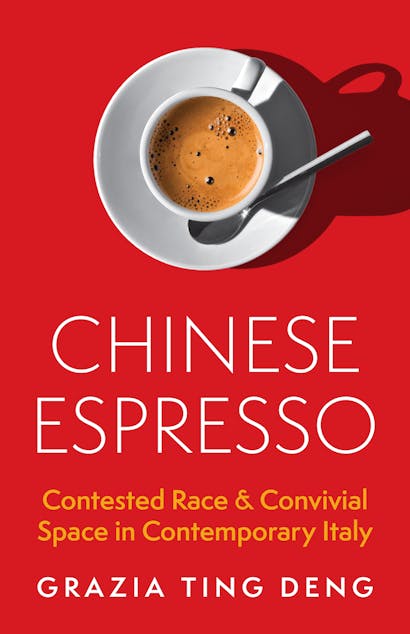
Grazia Ting Deng. Chinese Espresso: Contested Race and Convivial Space in Contemporary Italy. Princeton University Press. Princeton, New Jersey. 2024. 288 pages. ISBN: 9780691245799
Dr. Andrew Mitchel (Eastern Washington University)
For many of us, coffee represents not only a beverage offering much-needed caffeine, but also a key means of social connection. Maybe we have a one cup, black, before we undergo any form of social interaction. Maybe we use coffee to lubricate social interactions with family, friends, or colleagues. Maybe we have our favorite local coffeeshop where we work on our laptop a few times a week.
Throughout Italy, these coffeeshops (simply bars) serving espresso-based, Italian-style coffee are a staple across the urban landscape. They serve this same purpose as community gathering space, but also represent nationalistic pride as an explicitly Italian entity. Dr. Grazia Deng’s study showcases the global, racial, and economic trends in the country — with a core focus on her fieldsite of Bologna — that have caused many of these bars to, over time, be increasingly run by Chinese immigrants. Deng asked three core questions: why, how, and when did this sector become a Chinese niche? How do these Chinese baristas foster conviviality? And, how does this sector form and perpetuate racial understandings in Italy?
Deng’s ethnographic approach focuses on classic, Geertzian ‘deep hanging out.’ She spent countless hours in bars across Bologna, oscillating between participant observation and observing participant by talking with staff, stepping behind the bar to help, and trying her hand at making her own espressos and cappuccinos to varying degrees of success (Deng 29-30). Deng’s discussion of positionality is exceptionally thoughtful: she discusses how she is read as a marked Other as a Chinese woman in Italy (Deng 33-34), and notes the gendered dynamics in these bars, where “men linger…while women…leave quickly” (Deng 77). Her discussion of where she stands in these relations displays not only the trust and rapport she built with these bar owners, but the many “frictions of encounter,” including racial and gendered dynamics, present in these bars (Deng 34).
How, then, did many of these bars come to be run by Chinese immigrants? Deng describes how their presence is on the decline as operation costs balloon, competition gets tighter, and ‘trendy’ bars that offer coffee during the day and cocktails at night increase in popularity. The most common form of this bar, at least in Bologna, is a small space with a counter, a few tables (many of which are alfresco outside) that is staffed by two to four workers who are often members of the same extended family. Chinese owners have filled an existing niche and rely upon this familial labor of parents and children. While this demographic change has inspired some racist rhetoric about an invading labor force or an attempt to tie these businesses to an imagined Chinese mafia (Deng 37, 65), it is often the case that aging Italian owners sell their bars to Chinese entrepreneurs as the work is faticoso (tiring and laborious), demanding long hours a newer generation of Italian (including the children of the original owners) do not want to work (Deng 42-43). This process is occurring not just among these bars, but in a plethora of food service workplaces across Italy (Deng 44) and in other Global North contexts, raising important questions about conditional belonging, migrant labor, and business acumen. Many Chinese businesspeople who run these bars told Deng they buy them as an investment for their children and to be their own boss. They see the benefits of working in a liquid industry that offers a daily cash flow, functions as an investment that can be sold later on, and operates as a space with limited overhead and labor costs (Deng 55-56). Bars also represent a shift for many Chinese owners, whose prior work in Italy was largely in small-scale manufacturing in spaces like Prato’s clothing industry. Deng describes that the type of labor viewed as faticoso is conditional and contextual: for these Chinese families, bars simultaneously represent a workplace, an investment, and a marker of their growing success in Italy.
Deng shows how Italian bars as “fundamental places of urban sociability that embody and imply particular social relations” that are organized by class, age, and gender (Deng 70). These spaces are embedded into local communities as places to play cards, read the paper, and pass time chatting with old friends and new acquaintances. Many of these barshave expanded their offerings beyond just coffees, pastries, and other quick options: many now offer convenience store products like tobacco, and a game room, with the contentious presence of slot machines as a means of expanding their income. This balancing act between maintaining existing sociality and making measured additions to these bars shows the contentious labor taken up in these spaces by Chinese. While some have rebranded into ‘bars of the future’ with updated décor, new types of drinks, and subtler changes like a curated Spotify playlist, others preserve these spaces as not invading outsiders, but guardians of an existing way of life (Deng 103).
Deng describes the many types of taste found in these bars, which are at once communal, industrial, sensory, subjective, and local. Customers crave consistency and familiarity that Chinese baristas meet by providing ‘proper,’ expected taste and experience. Deng expertly notes the increasingly deskilled labor it takes to make these espressos, yet that even operating such a machine demands that people making these drinks “embody sensory skills through repetitive practice” (124). There are certain societal standards, too, learned through time and experience; apparently, no Italian would ever have a cappuccino in the afternoon! There is also the maintenance of community in these spaces, where great service is memorizing the orders of regular patrons. This negotiation of taste demonstrates the embodied and sensory labor undertaken on a daily basis by owners. Broader societal rhetoric, Deng exclaims, shows who views these spaces as old and stuffy (even before the shift to Chinese ownership), and who is tolerant and patient with these operators.
Deng also examines the tenuous belonging faced by Chinese baristas in Italy through their racialization. A distinct Italians racial hierarchy demands these owners fit themselves in as “economically privileged but socially vulnerable” Others (Deng 175, 203). Italy’s conception of whiteness and blackness places Chinese bar owners in the middle as ‘Asians’ assumed to be docile and laborious. Because of the industry in which they work, baristas are connectors, serving customers of all racial and class backgrounds. Such a role, however, does not mean these baristas do not devise own racialized assumptions and stereotypes (Deng 181). Chinese in Italy live rigid, separate lives; Deng describes “social gulf” (Deng 195) between work and leisure for Chinese baristas who watch not local shows and sports, but Chinese media. Assimilation, therefore, is uncommon; many of all ages told Deng they wanted to move back to China, or even to places like the United States, as they feel ignored, marginalized, and disillusioned within Italy’s culture and economy (Deng 180). Deng concludes by noting a paradox that fuses her economic, social, and racial examinations: operating bars has bring increased monetary success for Chinese owners, but also more stigma. Said visibility reframes their labor as a daily negotiation as they make coffees and sustain local conviviality.
While Deng does only briefly bring her core ideas to a head in her Coda, said concluding remarks describe present dilemmas she was unable to cover in the main text: Sinophobia in Italy due to COVID; localized pride of success and perseverance within the Italian Chinese community; and a final thought about whether members of this community could achieve respectability or would continually face disillusionment (Deng 211).
I wrote this review during spring break travel in the Bay Area before heading back to Washington for spring quarter; seeking a quiet, sociable space to work, my friend and I sat for a few mornings in a Berkeley coffeeshop run by an Asian family. They embody the labor Deng describes in her Italian context, shaping sociality by quickly providing regulars like my friend their customary coffee order, recommending specific specials like their Vietnamese iced coffee, and sustaining a community space of quiet work, but also group conversation by people of all ages and backgrounds. Even as many of these third spaces are on the decline, we can think about how the social experience of knowing the person who makes your coffee most mornings, and that they allow you to sit at one of their tables for a few hours to craft your review, continually fosters sociality. Deng’s text is an enduring representation of these dynamics with careful discussion of how they function in a global yet inequal world; it is a perfect text for anyone interested in the Italian foodscape, migratory labor in food service, racial formation in a European context, a study of sociality and conviviality, and how the simple espresso shot might define, divide, and connect us all together.

 FoodAnthropology