David Sutton (Southern Illinois University)
I last wrote about The Bear[1] on this weblog about a year and a half ago, noting that it was one of the most detailed explorations of restaurant life of any show. Since then, we now have four seasons, as well as a few published scholarly articles on The Bear, so it felt like the time for a brief revisit. While many people, including myself, were disappointed by much of Season 3, which focused on the first trials of the upscaling of The Beef sandwich shop into The Bear fine dining establishment, Season 4 proved, at least for me, to be a return to form, centering once again the rich relational landscape of the show’s characters.
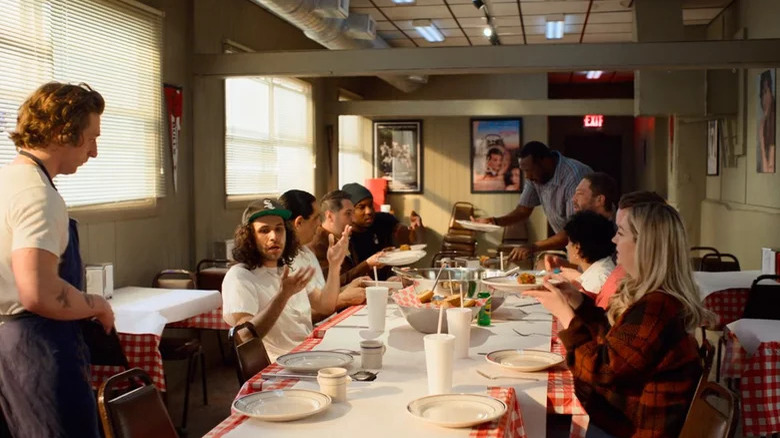
One insight late in Season 4 stood out for me and resonated particularly with previous anthropological research on restaurants. It was almost a throwaway line in the first meeting between the main character Carmy’s mother Donna (Jamie Lee Curtis), and the second lead, Carmy’s apprentice chef Sydney (Ayo Edibiri), at the wedding ceremony for “Cousin Richie’s” ex-wife Tiffany (Gillian Jacobs). In the scene Sydney talks about how great a chef Carmy is, how before she knew him personally, she went to his restaurant in New York because she so desperately wanted to try his food, and that it was the best meal of her life. Donna asks Sydney if she and Carmy are now close, to which Sydney responds with a hesitant “I think so” and a laugh. The dialogue continues from there.
Donna: You see that’s exactly what I was talking about. Isn’t that strange?
Sydney: What do you mean?
Donna: Like what I was saying. Like sometimes your work family is closer to you than your family family.
Sydney: Oh, well, um, I mean, sometimes I feel like your work family is like part of your family family, though. You know, it’s like one big…family family.
Donna: Yeah…if you’re lucky. (Season 4, Episode 7 “Bears” 32:30-34:50)
I focus on this scene because it captures for me one aspect of The Bear’s insight into restaurant work/life, which I want to unpack a bit in this post.
When David Beriss and I edited the first anthropological collection of essays of restaurant ethnography (2007), one of the themes that we were interested in bringing out was precisely the way that kinship connections are created in the context of restaurant work. Drawing on the burgeoning of kinship studies in the 1990s that showed the way that families do not simply “eat together,” but eating together in a real (not “fictive”) sense can create family ties,[2] our contributor Michael Hernandez (2007) described this process as part of his experience of working in a Chinese restaurant and becoming an adopted son of the owner, sharing “family” meals, and many other life lessons. Now this can presumably happen in many work situations, and has been the theme of many TV shows, where work families become, in Donna’s phrase, “family families.” Think back to The Mary Tyler Moore Show, The Bob Newhart Show, or M*A*S*H (to date myself). Indeed, the premise of many shows that are not about traditional genealogical families is that the people in them, nevertheless, become family by spending time together (anything from Cheers to Parks and Rec or even The Office). Food is a little different, adding another dimension to the notion of work families becoming families.[3] But what is notable about The Bear, as I argued in my previous post, is that so few TV shows have thematized family in the context of restaurants. Of course, family has its plusses and its dysfunctions, as one of our other contributors, Winnie Lem (2007), showed specifically in describing the hyperexploitation of genealogical family members in a Parisian Chinese restaurant, and implicitly in many “ethnic” restaurants. One of the main themes of The Bear is how dysfunctional Carmy’s genealogical family actually is. This plays out in Season 4 in terms of Carmy’s eventual reconciliation with Donna, marked by his cooking of a simple meal for her in her kitchen. But this element pulls against the other major theme of the series, which I explored in my earlier essay: gentrification.
How do family and gentrification pull against each other in The Bear? I want to briefly nod to some recently published work on the show and add a few of my own thoughts on this. Alessandra Serra (2024) notes the portrayal of the dysfunctional family—what she calls the pervasive/invasive relationship—is a key theme found not only in The Bear, but in many portrayals of Italian American family life in media. She further notes that characters are often shown as forced to choose between personal advancement and cutting family ties or embracing family while still achieving career success (118). This is shown in Carmy’s back-and-forth efforts to “fix the restaurant” and “fix the whole family,” and thematized in the restaurant “family meals” that occur at the end of both Season 1 and Season 2.
The personal advancement theme is most related to the exploration of gentrification throughout the series. As Serra argues, this is not just the dilemma of individuals like Carmy, but of cities like “Chicago, entrapped in a hybrid chasm between glamorous gentrification and a provincial – but very definite in identitarian terms – past” (119). This is explored by Zlatina Nikolova (2025), who argues that “The Beef’s family warmth is replaced by the cold ambition of The Bear [in Season 3]” (54). Nikolova’s article parallel’s my own earlier post on how the shift from The Beef to The Bear represents an embracing of Neoliberal ideologies. But where I focused on time and how it is represented in the show, illustrated by the mantra “Every Second Counts,” which precludes the kind of enduring social/family relations that take time, Nikolova makes a similar argument focused on space and place.[4]
Nikolova is arguing that The Bear encapsulates this contradiction, not only in Season 1, when Richie and Sydney clash over gentrification in an episode involving the relationship of The Bear to the larger neighborhood (cf. Vi 2025), but also in Season 3, in characters like Tina, who through her personal connection to Carmy’s brother “Michael, who offers her a lifeline in a crisis,” allows the series to “assert the restaurant as a place with memories and stories, impossible to replace,” at least in its iteration as The Beef (Nikolova 50). This tension is explored in relation to the extensive use of montages of Chicago landscapes in Seasons 2 & 3, representing the non-place view of Chicago as a place of “progress and productivity” (43).
Thus, the scene with which I began this essay represents an at least temporary resolution in which family and a successful version of The Bear restaurant are in theory possible. The season ends (spoiler alert) with the clock set up by Carmy’s uncle Jimmy to indicate how long the restaurant had to become financially viable running down to zero. This happens just as Carmy is shown seemingly stepping back from The Bear to work out personal and family issues and turning the restaurant over to Sydney—now fully incorporated into the Berzatto (Bear) family.
As a streaming series, The Bear continues to provide meaningful material for reflection on the relationship of commodification and the market to meaningful lived experience and personal and family relationships to “business,” an enduring theme in Italian American popular representations and beyond (cf. Sutton & Wogan 2003). I can’t wait to see what Season 5 has in store for us.
References Cited
Beriss, David, and David Sutton. 2007. The Restaurants Book: Ethnographies of Where We Eat. Oxford: Berg.
Carsten, Janet. 1995. “The Substance of Kinship and the Heat of the Hearth: Feeding, Personhood, and Relatedness among Malays in Pulau Langkawi. American Ethnologist 22(2):223-241.
Hernandez, Michael. 2007. “Forming Family Identity in an American Chinese Restaurant: One Person’s Transformational Process.” In D. Beriss & D. Sutton eds. The Restaurants Book: Ethnographies of Where We Eat. Oxford: Berg, 25-34.
Lem, Winnie. 2007. “Daughters, Duty and Deference in the Franco-Chinese Restaurant.” In D. Beriss & D. Sutton eds. The Restaurants Book: Ethnographies of Where We Eat. Oxford: Berg, 133-150.
Nikolova, Zlatina. 2025. “’Every Second Counts’: Urban Affect and Culinary Chaos in The Bear.” Journal of Popular Television 13(1): 43-59.
Serra, Alessandra Olga Grazia. 2024. “The Bear: New (Stereotypical) Representations of Italian Americans in Contemporary Television Series.” Forum Italicum 58(1): 114-124.
Sutton, David, & Peter Wogan. 2003. “The Gun, the Pen, and the Cannoli: Orality and Writing in The Godfather, Part I.” Anthropology and Humanism 28(2): 155-167.
Vi, Kieu Jenny. 2025. “Cooking Up Change: Food and Gentrification in The Bear (2022-).” In Progress: A Graduate Journal of North American Studies 3(1): 105-119.
Weismantel, Mary. 1995. “Making Kin: Kinship Theory and Zumbagua Adoptions.” American Ethnologist 22(4): 685-709.
[1] Note, when in italics, “The Bear’ refers to the streaming series. When in normal font, it refers to the restaurant opened at the end of season 2.
[2] Carsten 1995; Weismantel 1995.
[3] This is thematized in an episode late in the run of Mad Men, in which Peggy is trying to come up with an advertisement for the chain Burger Chef which moves from focusing on a traditional nuclear family having the “problem” of mealtime solved by Burger Chef, to inverting the formula. As Peggy puts it: “What if there was a place you could go, and there was no TV, and you could break bread, and whoever you were sitting with was family?” The episode ends with Don, Pete and Peggy pictured as one of many “families” eating in the house of Burger Chef (Season 7, Episode 6 “The Strategy.”)
[4] Space and time are, of course, never separable, as Nikolova argues that the transition of The Beef to The Bear involves a contradictory move to what anthropologist Mark Auge calls a “non-place,” that is, a place without history. Nikolova also uses “Every Second Counts” as I did, in the title of her article.

 FoodAnthropology