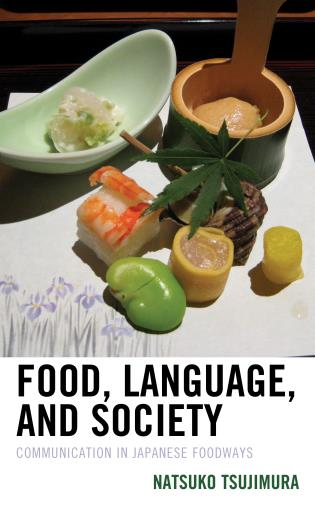
Natsuko Tsujimura. Food, Language, and Society: Communication in Japanese Foodways. Lexington Books. New York. 2023. ISBN: 9781498571333. pp. 287.
Richard Zimmer (Sonoma State University)
How do we talk about food in all its aspects? What are the words that we use? Why do we use them? How are they constructed linguistically? How do these food words reflect a society, including aspects of gender? How do they relate to other societies, especially in a globalized food world? Natsuko Tsujimura, a noted scholar of Japanese linguistics, raises these questions in general and then explores them by focusing on Japanese foodways. She does so in a highly readable work, useful for students of language, food, and cultural studies.
She first addresses loan words, words borrowed from other countries and other languages, now in Japanese foodways. Starting with the Portuguese presence in the country in 1543, Tsujimura extends her analysis to the ways in which many foreign influences created and/or changed the transformation of the “original” foreign word into Japanese. One example: source word—”‘sandwich. Loan word: sandoicchi. Loan word clipped: sando’” (17) She provides detailed discussion of these word changes in terms of accents and fusing patterns, noting that foreign influence will continue, mirroring how “…people think about themselves and others” (35).
Tsujimura then dissects the ways in which food is featured. She focuses on mimetics—the words to emulate something, in this case, food. Setting her discussion in terms of studies on the appeals of food, she explores taste, visual, smell, and sound words that preface the presentation of food in Japan. One example: karikari “…depicts the sound that domestic squirrels and hamsters as pets make when they crush [the specific snack] with their teeth. The cross-modal references as a highlight selling point of the millet and rice cracker for small pets readily connect to people’s experiences with the crispiness of rice crackers, for which we envisage the same sound and texture” (47). She extends mimetics to all the senses of food: “… it is no exaggeration that the mimetic vocabulary contributes much to the food discourse through a mosaic of sensual reactions inherent in the word class” (94).
She then situates her discussion in larger semantic terms, in part drawn from Levi-Strauss, Bourdieu, George Lakoff, and others. She notes the difficulty and often impossibility of using one-to-one foreign to Japanese equivalents in terms of cooking and preparing specific foodstuffs. There are eight different compound terms, for example, for how to boil something (123). There are eleven different compound terms to cut food into different shapes (128). One must therefore be attentive and sensitive to the specifics of taking foreign loan words into another language. Tsjimura concludes this first part of her discussion by addressing the ways in which metaphors in Japanese language and culture “…enrich the expressive power in the language of food” (162). These metaphors work in two ways: describing food and using other cultural events in terms of food metaphors “…attesting to the depths at which the concept of food is embedded in our culture and society” (169).
Tsujimura then explores the ways in which Japanese language works in places where food is written about. She first places her discussion within the larger discussion of food writing. Citing Lakoff, for example, she notes that “…the knowledge of food in different contexts of communication, both spoken and written, can be regarded as markers of identity since ‘culinary preferences and sophistication contribute significantly to our sense of ourselves’ [p.165.)]” (168).
She expands her discussion of Japanese cookbooks over time, starting in the Twentieth Century. The style of writing cookbooks changed throughout the Twentieth Century, with accompanying changes in language. The cookbooks she analyzed were oriented towards women readers, initially talking in instructive ways. These included placement of verbs and long sentences, broken into specific steps. Later, more informal ways of writing appeared, including “personal anecdotes” (179). She notes, earlier, that cookbooks, recipes in food magazines, and social media have now formatted cooking instructions “…into shorter and numbered or bulleted sentences…”(173). Tsujimura adds that “…an English phrase or loanword caters towards younger audiences accustomed to globalization of cuisine and culture in general” (181). She concludes this part of her discussion with a focus on one of the more important cookbook writers of the latter part of the Twentieth Century, Katsuyo Kobayashi. In a deep analysis of her use of language, she contends that Kobayashi is seen by her audience “…as a progressive woman who strives to strike a balance between her role in the workplace and at home”(200).
Tsujimura continues her focus on the gendered aspects of Japanese food writing by exploring the changes in the connection between men, food, and food writing geared to men over the last century. Palpable masculinity, even hyper masculinity, was “imposed” on the drinking of coffee in the last half of the Twentieth Century (216). Furthermore, men did not cook at home. In the 1970’s, however, men increasingly did so. Eventually, it become more common for men to cook and to participate in commensality, so much so that gender neutrality is achieved. (244-5).
This book is especially useful to students of language, culture, gender, and the Japanese language. It fits in with the global understanding of the ways in which food is accompanied by the language accompanying it. It is appropriate for upper division and graduate students as well as academics and food professionals, including advertising agencies.

 FoodAnthropology
1 Comment