
David Sutton (Southern Illinois University)
After this summer’s release of season 2 of The Bear on Hulu, it seems that anyone interested in the world of food, if they hadn’t tuned in already, was watching the story of a Chicago sandwich shop being transformed into a fine dining establishment. The Bear was unusual in a number of respects. While there are many movies that attempt to capture the workings of restaurants from the perspective of waiters and chefs, there are very few serial shows that do so.[1] Yet nowadays, at a time when cooking shows and food TV of various varieties seems to be everywhere, it is curious that more fictionalized accounts of restaurant work and restaurant life have not been portrayed in this format.
The Bear stands out certainly for the way that it throws us into a restaurant kitchen, capturing the intensity almost in the mode of a Durkheimian ritual of collective effervescence, full of senses, emotions, specialized language, and the sense of shared identity that can emerge from this experience. This high intensity is maintained in Season 2, which focuses on turning “The Beef”[2] into a fine dining establishment, and the questions about gentrification raised in the process. This is explored through the character of “cousin” Richie,[3] who in Season 1 worries about the closing of many neighborhood establishments—including other restaurants and bars—and their replacement by “upscale” chains like the salad and “bowl” chain Sweetgreen. Richie wonders if the main character “cousin” Carmy and his protégé Sidney plan to take The Beef in this direction, forcing the neighborhood to go the way of “Logan, Wicker, Pilsen,” other Chicago neighborhoods that have been transformed by gentrifying forces in the past 20 years. As Richie says to Sidney: “That’s why I keep telling you guys, stop fucking with this place. You know, you let up a little bit, everything changes. You don’t realize this is a delicate ecosystem. It’s held together by a shared history, and love and respect.” The plot of this episode focuses on Richie’s ability to convince locals involved in gang territorial conflicts to not scare away other customers of The Beef in exchange for free food from the restaurant.
While this episode from Season 1 gives a nuanced view of issues surrounding gentrification, Season 2 takes the show in a different direction, as Richie (and other characters, more or less willingly) must adjust to the upscaling of The Beef into The Bear. Here one might want to be more critical of the fact that the show puts us in the position of rooting for Richie to adjust to the new reality; it is shown to be the only possible hope he has to succeed, to stay employed, and to remain part of the family. This journey is portrayed mostly in Episode 7 of Season 2, “Forks,” in which Richie interns (“stages”) for a weekat a fancy restaurant in order to raise his game so that he can work at the revamped “Bear.” While initially resistant to the seemingly meaningless task of polishing hundreds of forks until they shine, Richie slowly is transformed by the passion for perfection expressed by his co-workers at this restaurant and returns to the Bear himself transformed—he now wears a suit to work—and with a new attitude about the importance of professionalism that at first makes him almost unrecognizable to Sydney and his other coworkers. This is the highest rated of any episode of the series so far, earning a 9.7 from users on IMDB. Many reviewers express their pleasure that Richie “redeems” himself and becomes more likable in this episode.
One small detail that struck me in watching “Forks” was the book that Richie is shown reading while at home preparing for another day of the internship. It is Unreasonable Hospitality by Will Guidara. Will Guidara was manager and eventually co-owner of the New York restaurant Eleven Madison Park, where the main character Carmy is shown learning the chef’s craft under grueling, even abusive conditions. The use of Unreasonable Hospitality as a prop intrigued me because, having recently read it, I was struck by the way that hospitality is framed in the book. In some ways this is a management “how-to” guide, filled with advice catchphrases like “Hire the Person, not the Resume,” and “Keep Emotions out of Criticism” much in the tradition of updated scientific management. More interesting to me, Guidara describes the lengths that the staff will go to in order to make the customers feel special; such acts as taking a family sledding in Central Park after their meal because they came from Spain and had never seen snow before. Guidara distinguishes between hospitality and luxury, the latter being simply excess, and the former being about listening to your customers—sometimes literally eavesdropping on them, so that you can serve them a New York hot dog, since this was the one thing that they had not had during their visit to the city. As Guidara puts it, “When we were with a guest, we were with that guest…We were no longer in the business of running an extraordinary restaurant; we were now in the business of human connection” (183), and “it isn’t the lavishness of the gift that counts, but its pricelessness” (209, emphasis in original). Guidara simultaneously insists that you should be extremely focused on the cost of most of the items in your restaurants, what he calls the 95/5 rule, or “manage 95 percent of your business down to the penny, spend the last 5 percent ‘foolishly’” (46, emphasis in original). He suggests that by allowing restaurant workers to be involved in the “creative process of giving gifts,” you can “make the business more profitable.”[4] The technology of surveillance is striking here as well. There is a staff member called the “Dream Weaver” dedicated to finding out as much as possible about the guest, so that they have the information they need to make these special moments happen. How different this is from the knowledge that develops between restaurant workers and regulars who, through an emergent, developing relationship, might learn a lot about each others’ lives, but not with the intention of turning that knowledge into a high-end “experience.”[5]
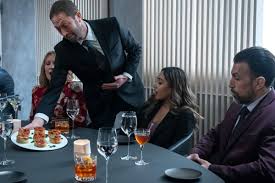
This blend of calculation and generosity, commodity and gift, is referenced in the restaurant where Richie interns. The show highlights an example that could have been taken straight out of Guidara’s book when Richie runs out to get a Pequod’s deep-dish pizza (famous in Chicago for their burnt crust). The chef then arranges the pizza artistically (cut into bite-sized rounds, garnished with basil gel on the side, and topped with micro-basil, about which Richie, in his enthusiasm, comments “micro-basil, fuck yes!”) for a family who had been overheard that they were leaving the city without having tried Chicago-style pizza. Richie is given the opportunity to serve this dish, which he does while dialoguing with the table (“my personal favorite pizza, “Manga baby!”). This, then, blends the careful standardization of serving manner with Richie’s more spontaneous and authentic sounding banter. In Richie’s hands, the technology of surveillance is turned back into a simple technique of attentiveness, fully in sync with Richie’s outgoing character. No doubt Guidara employs waiters who naturally exude these qualities, making it seem a bit less…creepy.
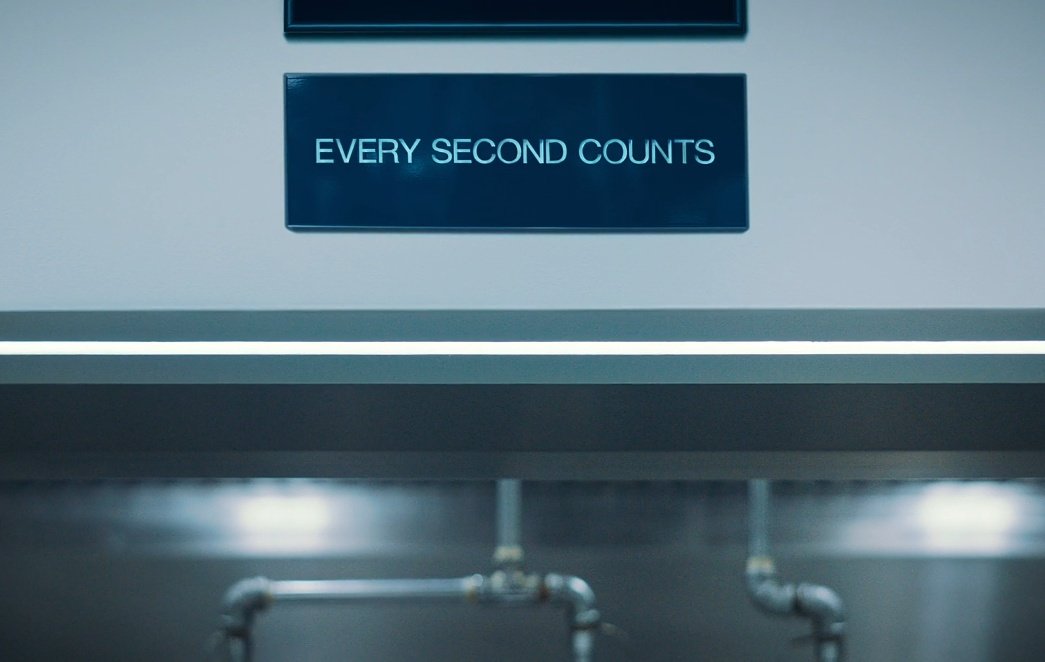
This seemingly extravagant use not only of money but restaurant time is made possible, it is suggested, by the constant vigilance over wasted seconds, emphasized in the sign that hangs over the kitchen “Every Second Counts.”[6] This is taken as an existential message about life choices in the final scene of the episode. But it also is emphasized in the one moment that suggests that this restaurant may be far from a paradise of respect, as the Chef de Cuisine and the Manager berate the staff for the loss of 47 seconds caused by what is referred to as “the smudge,” discovered on one of the dinner plates, which no one will admit to. Richie’s mentor, Garrett, is humiliated in this scene, as the Chef de Cuisine ends his tirade by shouting “Fuck you, Garrett,” to which he responds, “yes, Chef, Fuck me.”
Richie’s story is indeed moving and “redeeming,” seeming to suggest that if more people were respected in their jobs, they would derive more from them without suffering burnout and other, more serious pathologies that The Bear highlights. I have my hesitations, however, as to whether the unreasonable hospitality featured here, with its promise of “seeing others” and of “relationships,” is the solution to what ails the restaurant industry, or the larger society. In classical anthropology of the Mediterranean, hospitality is seen to be about gift giving, indeed, but equally or more so, it is about power, the power to show that the guest is reliant on the host for the beneficence offered. In the restaurant industry power, mediated by money, often seems to work the other way: it is the guest who can impose their superiority on the hosts, mediated through the tremendous disparities in money. While Garrett stresses to Richie the shared cognate of care in hospitality and hospital, New York Times food critic Ligaya Mishan notes a different etymology connecting hospitality and hostile, tying what she sees as the growing hostility between restaurants and their customers—epitomized nowhere better than in the movie The Menu (2022)—to the transactional nature of high-end restaurant service that interrupts a purer interaction. Mishan puts her finger on the problem of commodification, or hyper-commodification in our contemporary food landscape: we who have disposable income expect to be able to be served, and fast, noting that in the film The Menu the trauma of fine dining leads the chef to divide the world into “givers” (those who serve) and “takers” (those who eat), usefully inverting Mitt Romney’s “makers and takers” gaffe from his unsuccessful presidential campaign. But this, Mishal notes, also turns interaction into transaction: “Perhaps it’s this veneer of welcome that can make the nickel-and-diming of a meal — which at base is a primal, intimate event, the entwined acts of feeding and being fed — seem jarring” suggesting that “’We desire to be served, rather than to engage” and calling back a time when hospitality meant giving: “whatever you have, however little it is — to a stranger who may not speak your language or know your ways, and asking nothing in return.”
Perhaps Guidara has found a way around these contradictions. He removed the trappings of business in his restaurant, to the point that Eleven Madison Park stopped using a computer for taking reservations or sending orders to the kitchen, or even using numbers to keep track of tables (e.g., “take them to table 23” (188)) because these things all reminded customers of the “transactional” aspects of the interaction (remember, though, this will increase your bottom line!)
And perhaps if the flawed but lovable workers at The Bear can overcome their many personal demons and succeed, so will the restaurant itself (no doubt the focus of Season 3). But while in Season 1 the show made efforts to at least acknowledge the larger contradictions of gentrification, these have faded from view in Season 2. Richie returns from his internship, noting that he now is someone who wears suits, and with a new devotion to service where every second counts and the customer with money to burn is always right.
Erickson, Karla. 2010. The Hungry Cowboy: Service and Community in a Neighborhood Restaurant. Jackson, MS: University Press of Mississippi.
Guidara, Will. 2022. Unreasonable Hospitality: The Remarkable Power of Giving People More Than They Expect. New York: Optimism/Random House.
Mishan, Ligaya. 2023. “When Did Hospitality Get So Hostile?” New York Times T Magazine February 10. https://www.nytimes.com/2023/02/10/t-magazine/restaurants-hostile-eating-out.html?searchResultPosition=1 Accessed 6/17/2023.
[1] The most popular such show, to my knowledge was the 1970s sitcom Alice, set in Mel’s Diner in Phoenix, Arizona. There was also a short lived “Frank’s Place” in 1987 based on a real restaurant in New Orleans. Recent serial shows set in restaurants include Sweetbitter (2018) on HBO (based the memoir of a server) and Gentified (2020) on Netflix.
[2] Based on a real restaurant, Mr. Beef in the River North neighborhood of Chicago. See https://thecinemaholic.com/is-the-bears-the-original-beef-of-chicagoland-a-real-restaurant/
[3] Referred to as “cousin” throughout the series, he is in fact the childhood friend of the two brothers.
[4] Interview with Will Guidara. New Books Network 11/2/2022. 50:25. https://newbooksnetwork.com/unreasonable-hospitality
[5] See, e.g., Karla Erickson’s ethnographic portrait of restaurant work and the relationship between waiters and regular customers The Hungry Cowboy.
[6] Another call back to Taylorist scientific management.

 FoodAnthropology
2 Comments