Shannon Caplan
Oregon State University
Fall 2025 was a turbulent time for the food social safety net and those who work with it, requiring new ideas or new approaches to older ideas to increase food access in communities. As structural and policy changes were implemented with short turnaround times, organizations have needed to react quickly in response. Building off past work with matching currencies, an organization I am involved with implemented a local currency in rapid response to a shock to the food social safety net and are looking to create a more resilient and robust version that is more proactive than reactive.
One of the biggest impacts was the passing of the federal H.R. 1 bill (also known as the One Big Beautiful Bill Act) signed into law in July. This bill included many changes to SNAP eligibility and the elimination of federal funding for SNAP-Ed, a state-administered educational program focusing on making healthy food choices, stretching food dollars, and increasing physical activity for low-income populations across the lifespan. While SNAP-Ed had over 30 years of demonstrated and increasing effectiveness through both direct education and policy, systems, and environmental change efforts, the elimination of federal funding led to massive reduction or sunsetting of programs across the country, including my own position with Oregon SNAP-Ed ending in August.
When SNAP benefits distribution were delayed in November 2025 due to the government shutdown, millions faced uncertainty in their food access, including not knowing when they might receive benefits. Locally, we were also concerned about broader food system impacts, especially the negative effects on local farmers at the tail end of the farmers market season. I am part of Fresh & Local, First!, a small non-profit organization working to make local food accessible and affordable for low-income community members while also wanting to ensure local growers earn an adequate income selling at farmers markets. We knew that losing SNAP dollars at the farmers markets would be a challenge for both consumers and vendors. Furthermore, while our local farmers markets participate in Double Up Food Bucks, a matching program for SNAP recipients, to expand reach, we were not sure what restrictions they would have in place as it is traditionally a matching program.
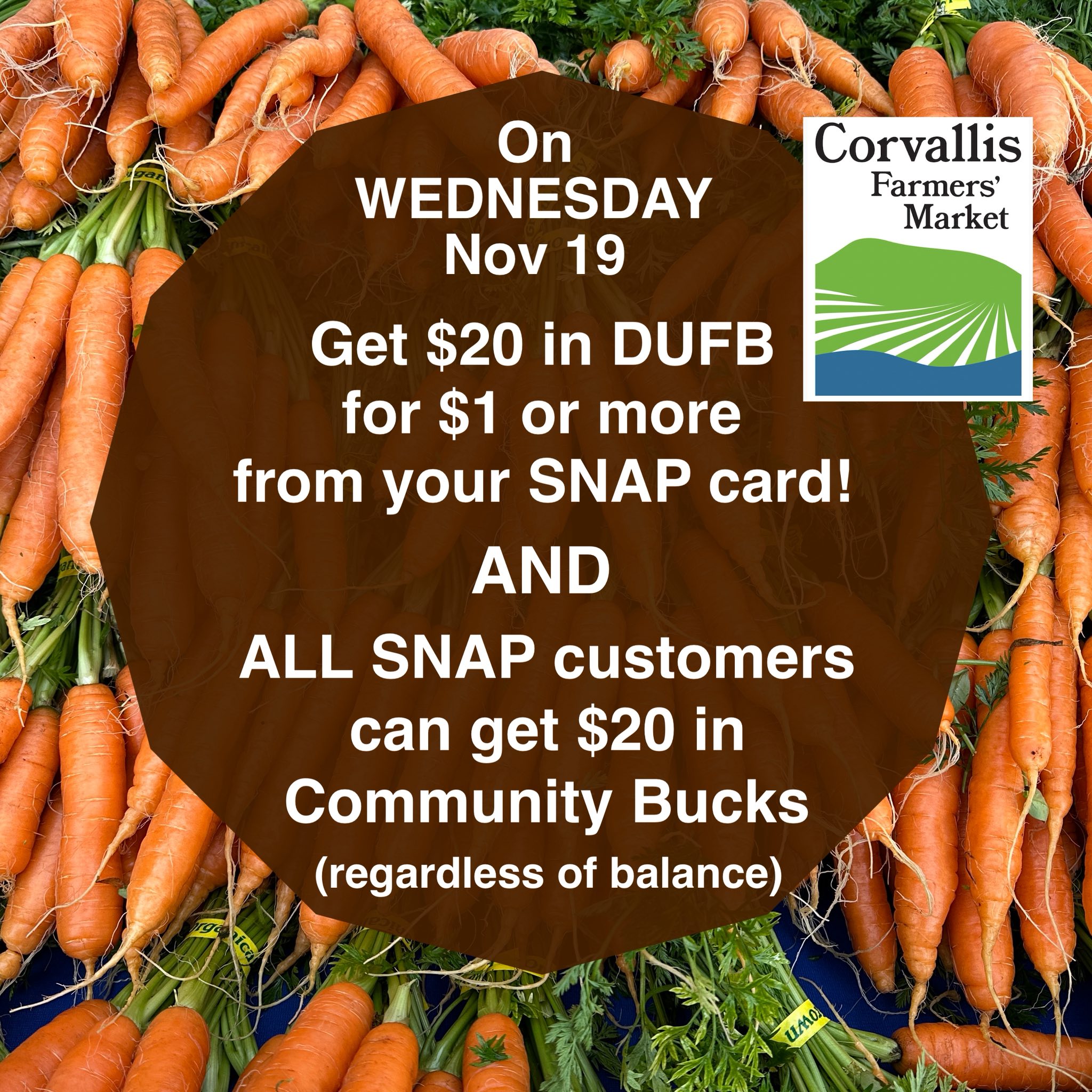
Fresh & Local, First! is run by volunteers, but we were able to quickly make decisions and get Board approval to utilize our funds to distribute “Community Bucks” to people with SNAP cards, even if their balance was $0, at our local farmers markets. People would be given $20 in vouchers to spend at the market by simply showing their SNAP cards. Because our local markets already utilize tokens or vouchers for SNAP and Double Up Food Bucks, we hoped that another voucher currency would not be overly complicated for consumers or market vendors. We were fortunate that the long-term farmers market director was coordinating with us on planning and implementation. We were able to have the volunteers and staff of the farmers markets distribute the Community Bucks vouchers and coordinate communication and bookkeeping tasks with vendors. They handed out vouchers to consumers who would spend them at vendors. Vendors would turn in the vouchers to the farmers market for reimbursement (as they would for SNAP tokens and Double Up Food Bucks), and Fresh & Local, First! reimbursed the market for the amount distributed in vouchers.
Thankfully, Double Up Food Bucks were also able to provide funds above and beyond matching during the SNAP issuance delay. Our launch date of Community Bucks coincided with the release of SNAP funds in Oregon, but their utilization demonstrated the interest in increasing spending at farmers markets. We were able to provide Community Bucks throughout November and are now in a financial recovery and fundraising phase as we hope to develop a more sustainable and resilient local currency. For now, we are focused on farmers markets due to the ease of reaching many vendors through a single hub and the ability to have finances run through the market rather than each individual vendor.
I am especially excited to expand food access and support to more vendors by broadening eligible food products. Double Up Food Bucks is a wonderful program but their funds cannot be used for meat purchases, as an example. We hope that vendors who previously were not benefiting from expanded purchasing power through Double Up Food Bucks will see increases in their customer base and income.
We are also looking to determine eligibility beyond simply participating in SNAP. We recognize that low-income households are losing access to SNAP or facing reductions in benefits due to changes in policy, not changes in need, and want to ensure they can be reached and that these households are not limited by the availability of SNAP to spend at the market. At the same time, we recognize that not all will be comfortable sharing income information in a public setting. Community partners and trust building will be critical to our recruitment and strategizing efforts.
If anybody has experiences or suggestions on creating and/or maintaining local currencies, please reach out to me at shannon.caplan@oregonstate.edu.

 FoodAnthropology